How We Use AI in Video Production (And What It Actually Costs vs Traditional Methods)

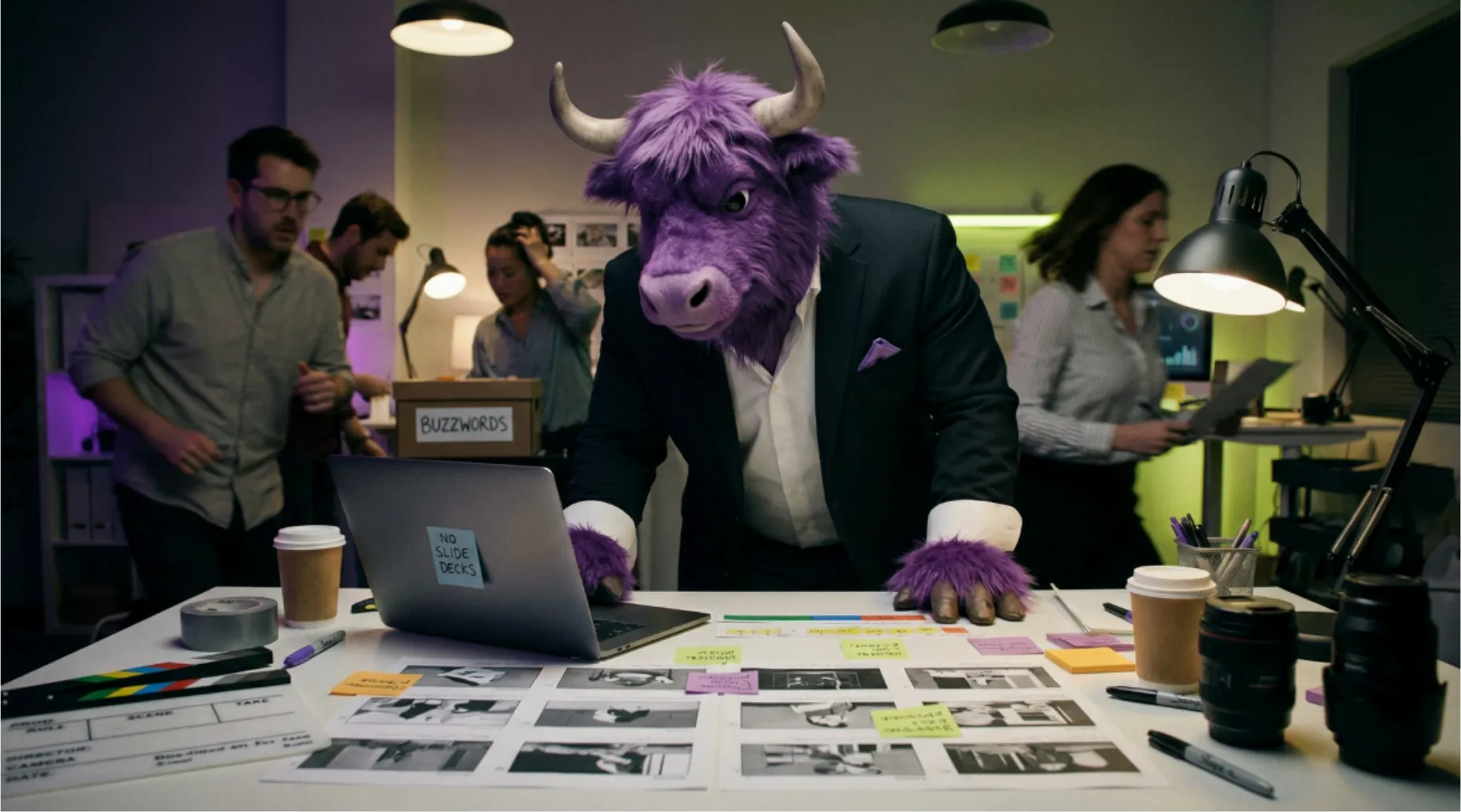
Most brands are past the “is AI real?” phase.
They’re here instead:
“We know we should be using AI for content.
But where does it actually help? What does it cost?
And when is traditional production still smarter?”
Fair questions.
AI tools exploded faster than anyone explained how they fit into real production. Or what they actually cost once you factor in direction, QC, approvals, and brand risk. Or when you should still just shoot it.
This is not a hype piece.
It’s what AI looks like inside a working studio — service by service — with real talk about cost, time, and where it works (and where it absolutely doesn’t).
Quick note on costs:
The ranges below reflect common patterns. Final budgets vary based on complexity, talent, usage/licensing, compliance, revisions, and deliverables.
How AI Fits Into Real Video Production
At Pixel Juice, AI is not the strategy.
It’s infrastructure.
We use it like cameras, edit suites, CGI, and motion design — as a tool to execute a creative decision faster or cheaper.
The question is never:
“What can we generate?”
It’s:
“What does this need to feel like — and why?”
Then we choose one of three paths:
Traditional shoot — when human reality is the point
AI build — when scale, speed, or impossible worlds are the point
Hybrid — real where it matters, AI where it saves
The Three Costs People Forget to Include
Most “AI savings” claims ignore the real costs:
Direction — locking look, rules, references, constraints
Quality control — catching drift, hallucinations, bad physics, broken continuity
Finishing — edit, grade, sound, comp, cleanup, deliverables
AI compresses production.
It does not replace judgement.
Service-by-Service Breakdown
1. AI-Enhanced Commercials & Paid Ads
(TVC / YouTube / Meta / TikTok)
What it is:
Performance-driven ads built to sell.
Where AI Helps Most
Pre-visualisation of 5–10 directions quickly
Environment builds without travel or scouting
Versioning hooks, cutdowns, variants without rebuild
Typical Impact vs Traditional
Time: ~30–60% faster when replacing heavy location/VFX setups
Cost: ~25–55% lower when shoot complexity drops
Where Humans Still Matter
Attention pacing
Message clarity
Continuity and brand consistency
Bottom line:
AI makes iteration cheaper. Direction stops it looking like a demo reel.
2. Brand Films
(The “feel something” work)
What it is:
The film that reinforces brand meaning.
Where AI Helps Most
Ambitious worlds without logistics
Visible metaphors without expensive builds
Early style testing before committing
Typical Impact
Time: ~25–50% faster
Cost: ~20–50% lower if large shoots are avoided
Where AI Can Hurt
Visually loud but emotionally empty
Weak human performance realism
Bottom line:
AI unlocks scale. Human direction prevents it becoming a screensaver.
3. Product Videos
(Clarity wins)
What it is:
Hero shots, demos, feature highlights.
Where AI Helps Most
Controlled, repeatable environments
One product, many contexts
Multi-market versioning
Typical Impact
Time: ~40–65% faster for multi-variant systems
Cost: ~30–60% lower replacing repeated sets
Where We Don’t Let AI Drive
Product truth
Fake features or UI
Packaging inaccuracies
Readability issues
Bottom line:
AI scales product content. Direction keeps it trustworthy.
4. B2B & Explainers
(Without the corporate coma)
What it is:
Clear, premium B2B storytelling.
Where AI Helps Most
Visualising abstract systems
Premium visuals without ballooning budgets
Fast turnaround
Typical Impact vs Traditional Animation
Time: ~40–60% faster
Cost: ~30–55% lower
Human Direction Prevents
Overdesigned nonsense
Patronising tone
Visual noise
Bottom line:
AI makes B2B clearer and cheaper. Direction keeps it sharp.
5. Social Content at Scale
(Without brand drift)
What it is:
Always-on content that stays recognisable.
Where AI Helps Most
Hook variations
Format shifts (9:16 / 1:1 / 16:9)
Fast iteration
Typical Impact
Time: ~30–60% faster for multi-deliverable campaigns
Cost: Lower per asset at scale
What Prevents AI Slop
Brand guardrails
Ruthless curation
Bottom line:
AI makes volume possible. Direction protects identity.
6. Launch Films & Event Openers
(Big moments, tight timelines)
What it is:
Reveal films, keynotes, sizzles.
Where AI Helps Most
Cinematic spectacle without VFX armies
Fast changes under pressure
Large-scale visual ambition
Typical Impact
Weeks compressed into days
Reduced VFX dependency when concept supports it
What Matters Most
Timing precision
Restraint
Bottom line:
AI delivers punch fast. Direction makes it land.
The Part Nobody Sees (But Everyone Feels)
Post-Production & Finishing
AI speeds cleanup and versioning.
But the final 10% is still human:
Rhythm
Emphasis
Taste
Knowing when to stop
Localisation & Versioning
Traditional versioning becomes mini-projects.
With AI/hybrid workflows:
One master
Clean adaptations
Locked style rules
No drift
When AI Doesn’t Save Money (And Can Cost More)
AI struggles when the challenge is human believability.
Costs rise when you need:
Tight lip sync
Crowd realism
Precise hand actions
In-camera text
Complex physics (liquid, fabric, collisions)
Tight continuity
Heavy legal or compliance oversight
In these cases, hybrid or traditional is often safer and cheaper.
What This Means for Your Budget
Across recent projects, teams typically see:
~35–60% lower production cost when replacing travel, sets, heavy VFX
~40–65% faster turnaround with early guardrails
Broadcast-ready finish when realism-sensitive shots are hybrid handled
What does not change:
Clear briefs
Taste
Quality standards
A process that prevents drift
AI compresses production.
It does not replace judgement.
When We Don’t Use AI
We choose traditional when:
Genuine human emotion is central
Practical effects are stronger
“Real” is brand positioning
AI would take longer
Brand risk is high
We use AI when it improves speed, scale, or affordability.
We shoot when that’s smarter.
Want to See What This Looks Like for Your Project?
We’re not selling AI.
We’re selling outcomes.
Bring a brief. We’ll show you three paths:
Traditional approach — time + cost
AI-enhanced approach — time + cost
Hybrid approach — time + cost
Then you choose.
Check more blogs
A quick overview of how we work together to make your edit best in class!