Fix these 10 workflows before buying another AI tool


Fix these 10 workflows before buying another AI tool
Fix these 10 workflows before buying another AI tool
Fix these 10 workflows before buying another AI tool
Before you buy another AI tool, look at the work it is about to inherit.
If the enquiry is missing context, the meeting has no owner, the proposal is called Final_v7 and the same spreadsheet lives in four folders, an agent will not save you. It will simply move the confusion faster and add a dashboard.
Here are ten workflows to repair before you spend another dollar on software.
The ten workflows worth fixing
1. Enquiry to prepared conversation
Gather the enquiry, history, relevant service information and missing questions. Do not let the system invent a budget or promise a result.
2. Meeting to action
Capture decisions, actions, owners, deadlines and unresolved questions. A summary without ownership is just a well-formatted memory.
3. Brief to first draft
Turn a loose request into audience, objective, evidence, constraints, deliverables and open questions before asking for copy or creative.
4. Proposal to review
Use approved services, case studies and pricing. Mark assumptions. Put commercial promises behind a human review.
5. Reporting to decision
Do not automate a beautiful report nobody reads. Define the decision the report should support, then surface the few facts that matter.
6. Customer question to reliable answer
Create a source hierarchy and show evidence. If the answer is uncertain, the system should say so and route the question.
7. Content idea to production pack
Turn an approved message into a brief, script, shot list, storyboard, visual directions, versions and review checklist.
8. Asset to approved distribution
Separate creation, review, accessibility checks, scheduling and publishing. “Generated” is not the same as “ready”.
9. Repetitive admin to exception queue
Automate the predictable part and make unusual cases visible. Do not hide uncertainty inside a green tick.
10. Insight to next experiment
Capture what was learned, what changed and what to test next. Otherwise every quarter begins with the same “new” idea.
The repair sequence
For any workflow, write down:
trigger
input
owner
steps
handoffs
approval points
exceptions
output
measure
Then ask where the delay really comes from.
Sometimes AI is useful. Sometimes the right answer is a clearer template, one shared folder, a deleted approval or a decision nobody has made yet.
Choose pilots by behaviour
The best first workflows are frequent, bounded, measurable and reversible.
Be wary of a pilot that has:
no clear owner
sensitive inputs with no control
a vague definition of success
an external action hidden inside the last step
a dependency on one person’s private account
Start with preparation and drafts. Add actions when the team can explain the exceptions.
What good looks like
A repaired workflow should be easier to teach, easier to review and easier to stop.
A new team member should understand what starts it. A manager should know where to approve it. The person using it should know what to do when the information is missing.
If the system needs a heroic operator to keep it alive, the workflow is not finished.
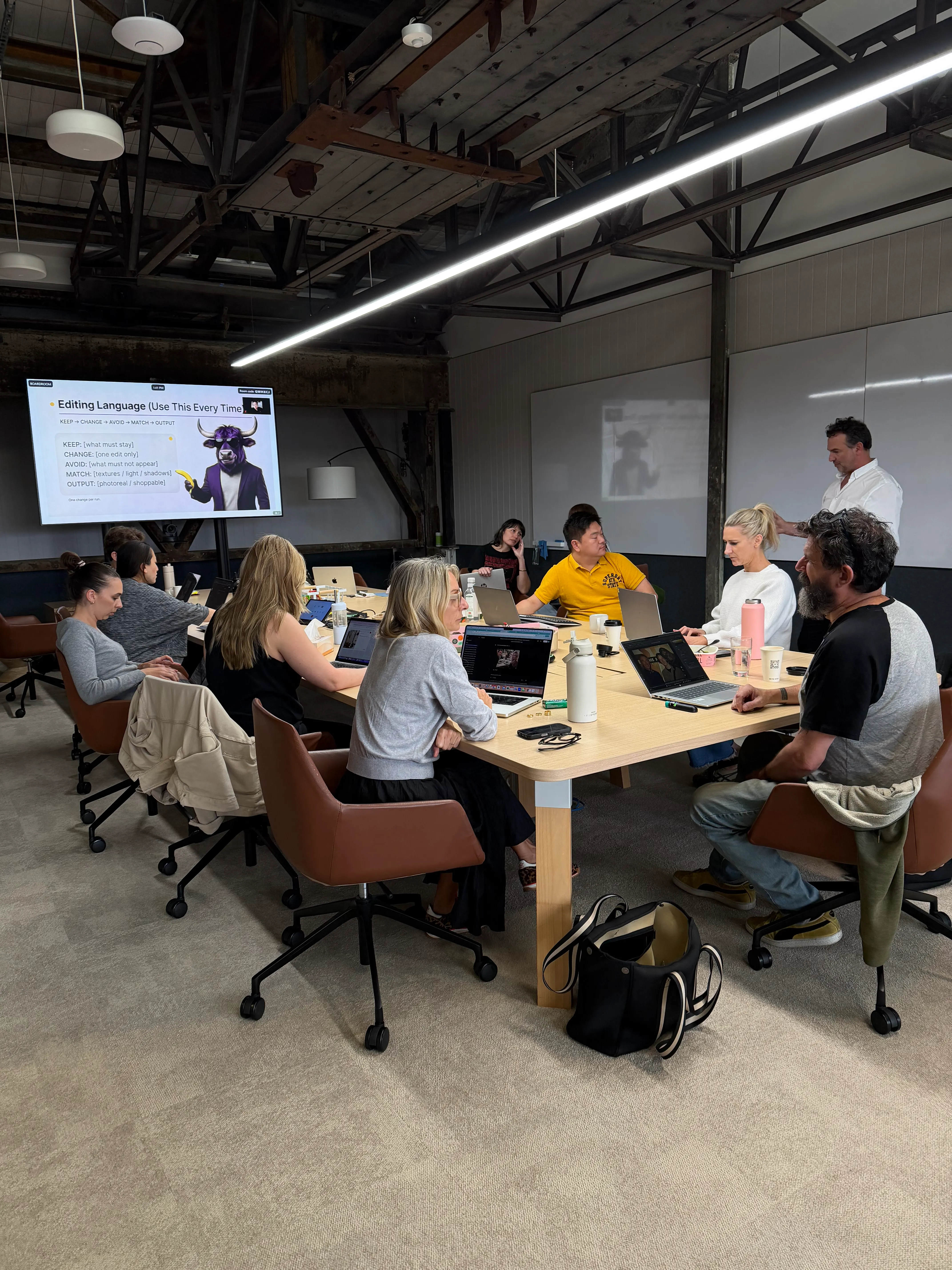
Workshop version
Exercise: workflow autopsy - 75 minutes
10 min: choose one workflow everyone complains about
15 min: draw the current version, including handoffs
15 min: circle delays, duplication and risky steps
15 min: design the smallest useful repair
10 min: add the human gate and exception path
10 min: choose a measure and a two-week pilot
Output: current-state map, repaired workflow and pilot brief.
The best AI tool may be the one you do not buy because you finally removed the step that was wasting everybody’s time.
Pixel Juice helps teams find and repair the work before adding technology to it.
For a practical, controlled rollout, explore our AI consulting and training services.
Related reading
Check more blogs
A quick overview of how we work together to make your edit best in class!